Mazes Game: Integrating Print-Ready Puzzle Assets into Publishing and Cognitive Workflows
In the landscape of low-content publishing, educational resource creation, and cognitive wellness products, efficiency often dictates success. For professionals ranging from self-publishers to educators and corporate trainers, the bottleneck is rarely the concept but rather the execution of high-quality, print-ready assets. The Mazes Game collection addresses this specific friction point by providing a pre-formatted, 75-page interior designed specifically for Amazon KDP and similar print-on-demand platforms. This resource is not merely a set of puzzles; it is a modular component intended to streamline production workflows, reduce technical overhead, and serve as a versatile tool for both commercial and personal development projects.
Defining the Asset in a Production Context
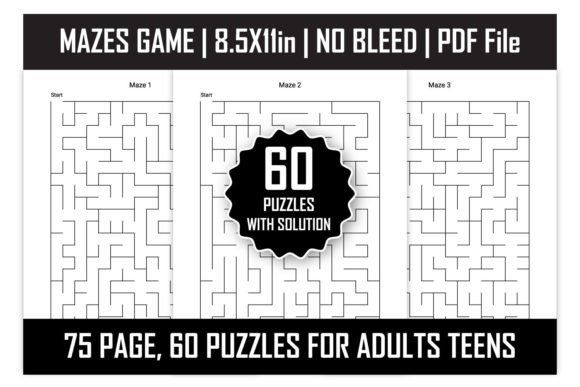
To utilize this resource effectively, one must understand its technical specifications and how they map to industry standards. This Mazes Game interior is engineered at 8.5 x 11 inches with no bleed, adhering strictly to standard trade paperback dimensions. The "no bleed" specification is critical for workflow efficiency; it ensures that margins remain safe during the trimming process, eliminating common rejection errors associated with artwork extending too close to the cut line. With 75 pages of newly generated content, this PDF serves as a substantial core for a standalone activity book or a significant supplementary section within a larger publication.
The distinction of "newly generated" content cannot be overstated in an era where duplicate content flags can derail publishing efforts. For marketers and publishers, originality is a risk management strategy. Using pre-existing or scraped maze templates can lead to copyright strikes or poor user reviews due to repetitive patterns. This asset provides fresh intellectual property that integrates cleanly into existing catalogs without legal or quality assurance liabilities. The high-resolution formatting ensures that lines remain crisp after printing, maintaining the professional standard expected by adult users and educators alike.
Strategic Applications Across Different Phases
The utility of a structured puzzle asset extends beyond simple entertainment. Depending on your role, this Mazes Game collection functions differently before, during, and after primary project phases.
Pre-Launch and Product Development
For KDP publishers and small business owners, the pre-launch phase is dominated by market research and asset accumulation. Sourcing individual mazes or hiring illustrators is cost-prohibitive and time-consuming. This ready-to-upload PDF acts as a foundational MVP (Minimum Viable Product). It allows creators to test niche viability—such as "mindfulness for professionals" or "cognitive maintenance for seniors"—without significant upfront investment. By integrating this interior, you can move from ideation to proof copy ordering in days rather than weeks, accelerating the feedback loop essential for agile publishing.
During Active Projects and Educational Workflows
Educators, therapists, and corporate trainers often require immediate, tangible tools for engagement. In a workshop setting focused on problem-solving or stress reduction, digital fatigue is a genuine obstacle. A physical Mazes Game booklet serves as an analog anchor. During team-building sessions or classroom transitions, these puzzles provide a structured cognitive break that resets attention spans without introducing screen-based distractions. Because the content is print-ready, facilitators can produce physical copies on demand, ensuring that materials are always available regardless of internet connectivity or device compatibility.
Post-Project Integration and Value Adds
After completing a major course, ebook, or consulting engagement, maintaining audience retention is challenging. This puzzle collection serves as an effective lead magnet or bonus deliverable. Coaches can bundle the PDF as a "mental decompression" toolkit for clients finishing a high-intensity program. Bloggers and content creators can offer the printable version as a newsletter incentive, driving list growth while providing genuine value. In this context, the Mazes Game transforms from a standalone product into a relationship-nurturing asset that reinforces brand loyalty through practical utility.
Technical Integration and Compatibility
Seamless integration requires understanding how this PDF interacts with broader design ecosystems. While the interior is complete, it lacks a cover, necessitating a complementary design workflow. When creating your cover, ensure the spine width calculation accounts for exactly 75 pages on white paper stock. Miscalculating page count is a frequent error when combining pre-made interiors with custom covers; verifying the page count against KDP’s calculator before finalizing cover art prevents costly reprints.
For those incorporating these mazes into larger manuscripts using tools like Adobe InDesign or Affinity Publisher, treat the PDF as a locked layer or placed object. Do not attempt to edit the vector paths unless necessary, as this can alter resolution. Instead, build your front matter, table of contents, and back matter around this fixed block. This modular approach preserves the integrity of the high-resolution source file while allowing flexibility in the surrounding content. If you are combining this with other activity types, such as word searches or journaling prompts, maintain consistent margin guides to ensure a uniform user experience throughout the final bound product.
Quality Control and Usability Considerations
Even with print-ready files, professional diligence requires verification. Before mass distribution or client delivery, order a physical proof. Digital previews cannot accurately represent ink spread on paper, which affects maze difficulty. Lines that appear distinct on a backlit monitor may bleed together on standard 55# or 60# paper, rendering complex paths unsolvable. Testing ensures the cognitive load matches the intended audience capability.
Consider the end-user's physical interaction with the book. Since this is a no-bleed format, verify that the safe zone margins provide adequate space for binding. Users should not have to crack the spine excessively to see the full maze path near the gutter. If you plan to bind this manually or use spiral binding for local workshops, adjust your internal margins accordingly. For KDP, the provided margins are optimized for perfect binding, but awareness of the physical constraints enhances perceived quality.
Workflow Efficiency and Long-Term Asset Management
Integrating pre-made assets like this Mazes Game is fundamentally about resource allocation. Every hour spent drawing mazes is an hour not spent on marketing, curriculum development, or business strategy. However, efficiency should not compromise organization. Maintain a strict version control system for your PDF assets. Label files clearly with specifications (e.g., Maze_Interior_8.5x11_NoBleed_75pg_v1.pdf) to prevent confusion with future editions or variations.
Think of this asset as part of a scalable library. As you acquire more print-ready interiors, categorize them by difficulty, theme, and technical specs. This metadata-driven approach allows for rapid assembly of future products. When a new trend emerges, such as "digital detox kits," you can instantly query your asset library for compatible components rather than starting from scratch. This systematic approach turns individual purchases into a compounding production infrastructure.
Ethical Use and Content Freshness
While this content is newly generated, responsible implementation involves adding unique value. Avoid uploading the PDF as-is without contextualization. Add an introduction explaining the benefits of maze solving, include solution keys in a logical format, or pair the puzzles with reflective journaling prompts. Search algorithms and human readers alike reward depth over bare-minimum compliance. By wrapping this raw asset in thoughtful curation, you distinguish your offering in a saturated marketplace.
Furthermore, respect the licensing terms associated with PLR or commercial-use assets. Ensure you understand whether modification is permitted or required. Even if allowed to sell as-is, customization improves long-term viability. Unique titles, bespoke cover designs, and tailored descriptions signal to platforms and customers that this is a distinct product, not a duplicate listing. This attention to detail protects your account health and builds a sustainable publishing or educational business.
Aligning Assets with Audience Needs
Finally, successful integration depends on matching the asset to the specific needs of your demographic. For entrepreneurs and freelancers, position the Mazes Game as a productivity tool for mental clarity and focus training. For educators, emphasize the developmental benefits of spatial reasoning and patience. For hobbyists and creators, highlight the meditative aspect of analog engagement. The versatility of a black-and-white, high-resolution maze interior lies in its neutrality; it becomes whatever your workflow requires it to be.
By treating this Mazes Game collection as a strategic operational component rather than just a file download, you unlock its true potential. It bridges the gap between creative intent and tangible output, reducing technical barriers while maintaining professional standards. Whether used to launch a new revenue stream, enhance a learning environment, or provide value to a community, this asset exemplifies how prepared resources can optimize modern creative and business workflows.